Through Our Own Window

     And yet, even as he thought of all these things, he noticed somehow that the sky was a lovely shade of blue and that one cloud had the shape of a sailing ship. The tips of the trees held pale, young buds and the leaves were a rich deep green. Outside the window, there was so much to see, and hear, and touch—walks to take, hills to climb, caterpillars to watch as they strolled through the garden. There were voices to hear and conversations to listen to in wonder, and the special smell of each day.

—Norton Juster, The Phantom Tollbooth

This passage from the next to last page in the book, at least that’s where it’s found in my edition, has been coming to my mind a lot in the past few days. At this point in the story, Milo has returned to his bedroom from his incredible adventure and is feeling lonesome for the characters he shared the adventure with and feels eager to rejoin them for another trip. The tollbooth and car have been taken away though, by someone whose signature is blurred, for other boys and girls who need to be shown the way, to have their senses and awareness opened.

Milo begins to see his familiar surroundings with a whole new perspective compared to the one he at the beginning of the story. He sees new in the midst of old. I don’t think this delivers the message (at least it doesn’t deliver it to me) that what is is always what should be. In other words, I believe that sometimes we do need to change that which surrounds us rather than artificially molding our view of it — whatever that may mean. Opening our eyes and all our senses and looking through our own window with open senses can renew our perspective for what is beautiful in our world as well as what needs to change. Knowing the difference can be very tough because all is skewed by the lens and filter embedded within us, shaped by the total of our life experiences. When our eyes are open to what is truly beautiful, maybe we can then find the courage to be true to our own heart and change what is not.
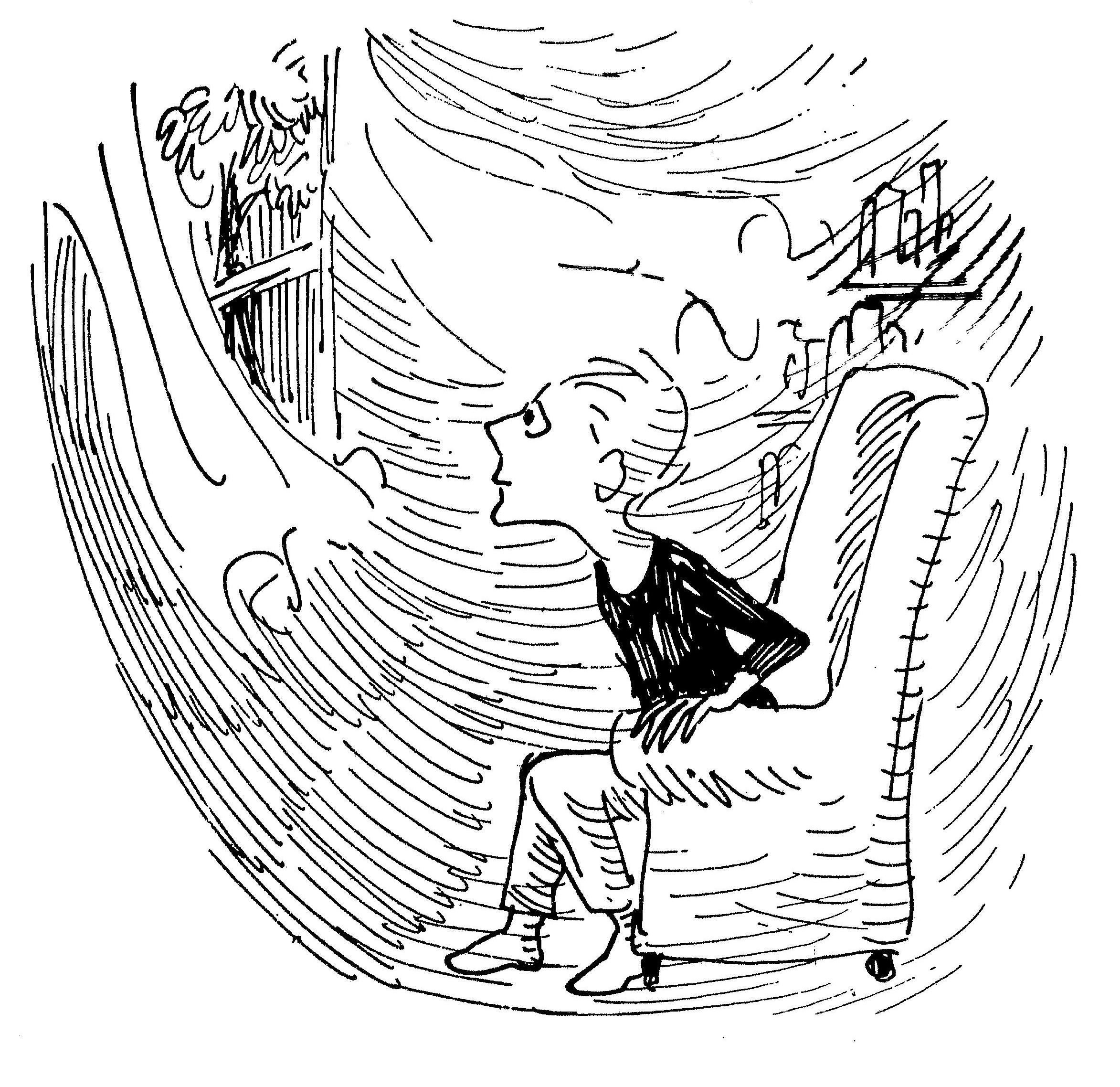
illustration by Jules Feiffer

illustration by Jules Feiffer

Aside: I wonder of Norton Juster and Lucy Maud Montgomery, author of Anne of Green Gables, were friends in another time. Anne: “Isn’t it splendid there are so many things to like in this world?” Another truth from Anne, this one from Anne of Windy Poplars: “One can always find something lovely to look at or listen to….”

What is the Real Thing?

So they lived. Everything went along without change and everything was fine.

“What if my entire life, my entire conscious life, simply was not the real thing?”

“But what is the real thing?”

—Leo Tolstoy, The Death of Ivan Ilyich

I continue to re-explore some of the books that delivered crucial truths to me at a pivotal time in my life. The Death of Ivan Ilyich was the second book assigned in my Western Classics II class during the fall semester of 2002. Whenever I think of this story, the words that come to my mind first are “inauthentic life.” I read this story and cried for the Ivan in all of us, but mostly for the Ivan in me. I did not want to continue living my own inauthentic life. Mine was very different from Ivan’s, but still not real even though it may have appeared to be fine to those who shared my world at that time. The hope this story holds was a needed light.

Ivan chose the right career, married the right spouse, bought the right house, filled the house with the right things, had the right children, went through all the right motions of life. Only on his death bed did he realize these were not the real things of life. For too long, I had been going through the motions of the life that I felt was expected of me. I suppose I expected it of myself just as much as anyone else did. We all want to be happy, and when we are young we have a picture in our mind of how a happy life should look. We can put the external pieces in place yet know some of the pieces don’t really quite fit. We go on with each day anyway, hoping not only that nobody else notices but that we will not notice. Sometimes, it was impossible to not see clearly that the pieces of my life did not only not fit but were probably not the right pieces at all.

My copy of Ivan Ilyich is well-marked and annotated. The quotes I chose above are only those that seemed to gather together the messages I grappled with as I read this the first time and as I ponder it now. When I closed the last page for the first time, I cried —really cried— for close to an hour. Beginning to learn truths can do that to us. The hope and light held even in the dark story remained with me, though. Hope and light have always had a way of finding me and helping me to find my way.

Discontent in the Happy Valley

“…I find one day and one hour exactly like another, except that the latter is still more tedious than the former. Let your experience inform me how the day may now seem as short as in my childhood, while nature was yet fresh, and every moment shewed me what I never had observed before.”

Rasselas, after a period of time between a realization that he needed to somehow find his way out to explore the world and find his own way:

“…but the months that have passed since new light darted into my soul, […] have been squandered by my own fault. I have lost that which can never be restored….”

‘Nothing, replied the artist, will ever be attempted if all possible objections must be first overcome.’

—Samuel Johnson, The History of Rasselas, Prince of Abissinia

When I began my bachelor’s degree at a non-traditional age, my very first class was Western Classics II at 8:00 on a Tuesday morning. I have always enjoyed books and the stories they hold but have never been a voracious reader, devouring books for purely entertainment. I have been long been one to mark and underline — annotating the text just as I annotate life.

The first book assigned to us was Samuel Johnson’s The History of Rasselas, Prince of Abissinia. (The title of this post is taken from the heading of Chapter 2.) As long ago as it was first published (1759), it was new for me. Although I could read for and process the ideas our professor was guiding us through, it was impossible for me to ignore several deep personal messages sent from the story to me. Our progressive and combined life experiences create a unique filter through which we process anything new that comes into our life. From the outside, most who knew the basics of my life would have assumed me to be content in the happy valley where I live. (I wrote the name of my town with a ? beside it the first time I came to that label —always italicized in the text— for the palace and grounds where Rasselas lived.) The discontent of Rasselas, though different from my own, and his quest to breach the walls of the happy valley to explore all the world held and to find his own choice of life (also always italicized) brought oxygen to a tiny little flame within me that had never been extinguished. And it began to grow.

I was very much at a point in life where I still felt trapped although I had taken one very important step toward making my life better: Going back to school. The obstacles to taking subsequent steps seemed overwhelming. And there was much beauty in my life even with the ugly that I kept secret. But the rumblings had begun. Scary as they were, I knew they were Good.

This post would be far too long if I shared every bit of text I underlined or highlighted. It is enough for me to put these thoughts down here and to turn back the pages of the book to read my thoughts and think about why I underlined and highlighted specific phrases, lines, or passages. The books I read over the next few years all are now like photo albums for me — full with images these markings evoke within my mind.

Taking a Step

“What saves a man is to take a step. Then another step. It is always the same step, but you have to take it.”

Antoine de Saint-Exupéry, Wind, Sand and Stars

This post does not address a truth gleaned from fiction as this book is a philosophical memoir, but it does begin a series of posts that mostly fit the theme of this blog. If you have only read The Little Prince, you need to find one of Antoine de Saint-Exupéry’s other books and read how much more wisdom this man has to share — from his own words and those of others he shared his incredible life with. In the past 10 years or so, he has become a favorite writer of mine.

Wind, Sand and Stars holds not only the quote above, but another of my favorite quotes of his: “A garden wall at home may enclose more secrets than the Great Wall of China.” The bittersweet beauty of that truth stays with me every day of my life. We do not and should not share everything that happens behind the walls of our home. But there are some secrets that should not be kept for the health of all who live within a home. How often do we take a walk, especially in the evening, and see a home lit from within and assume it is a happy home? How often have we heard news that informed us otherwise? How often, then, must it be true that the picket fences, the landscaping, the carefully chosen front doors enclose secrets we would never imagine.

There was a time in my life when I knew I needed to take a step. I had no idea how to take the step, but I kicked out my foot anyway. Each day, I keep taking that step. For too many years, I kept my feet planted in a place where I felt incapable of being authentic. What seems even more sad to me at times is that I don’t think I always realized that. I existed. When I needed to take that step, there are a few books (and authors) that helped to guide me into my first steps back to my self.

Although Wind, Sand and Stars is not one of those books, it did come to me at a time when I needed a reminder to keep taking the step. This is why I am choosing this quote to begin a series of posts on the truths that came to me from the pages of fiction at a time in my life when I profoundly needed them if I was to step beyond mere existence into an authentic and vivacious life. It has been quite a journey — one that continues.